
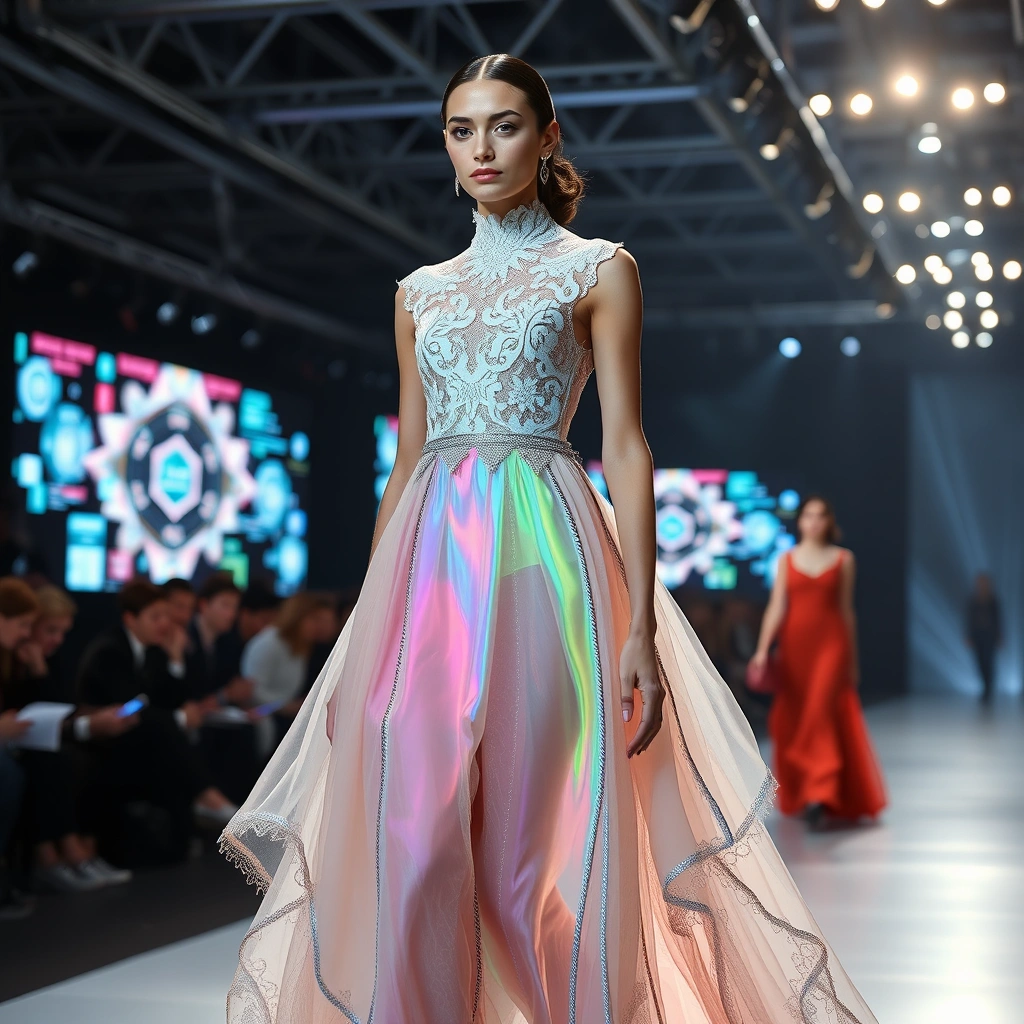
The Silicon Seamstress
In the heart of Paris Fashion Week, a new kind of muse took the stage—not a supermodel, but a neural network. Maison Lumière, a once-conservative couture house, unveiled its latest collection, generated entirely by an AI trained on centuries of textile archives. The result? Gowns that morph from Victorian corsetry to cyberpunk asymmetry in a single stride, their patterns shifting like living water.
This isn’t a gimmick, says creative director Elara Voss. ‘AI doesn’t replace the designer’s eye; it magnifies it. We fed the machine every sketch, every stitch error, every hidden desire from our sketchbooks—and it spat back forms we’d never dare imagine.’ The collection sold out in hours, a testament to a growing appetite for the uncanny.
Backlash and Blockchain
But not everyone is smitten. Traditional tailors in Milan protest, arguing that algorithm-made clothes lack the ‘soul’ of hand-stitched craftsmanship. Sweatshop-free, zero-waste production is a boon, yet the fear of homogenized style looms. Enter blockchain: fashion startups like ThreadChain now authenticate every AI-designed piece, tagging it with a unique digital fingerprint that tracks its carbon footprint and artisan collaborators. ‘Transparency is the new luxury,’ explains CEO Marco Bellini. ‘We’re not just selling a dress; we’re selling a provenance story.’
The Human Touch
Despite the tech tide, human hands remain crucial. At Stella Nova Atelier, designer Aiko Tanaka blends algorithmic patterns with hand-dyed silks, using AI to predict trend curves while she personally adjusts drape and fit. ‘My clients want the algorithm’s precision but my intuition,’ she says. ‘It’s a dance between data and dream.’
As the industry hurtles toward a hybrid future, one thing is certain: the runway is no longer just a catwalk. It’s a proving ground for the next industrial revolution.